
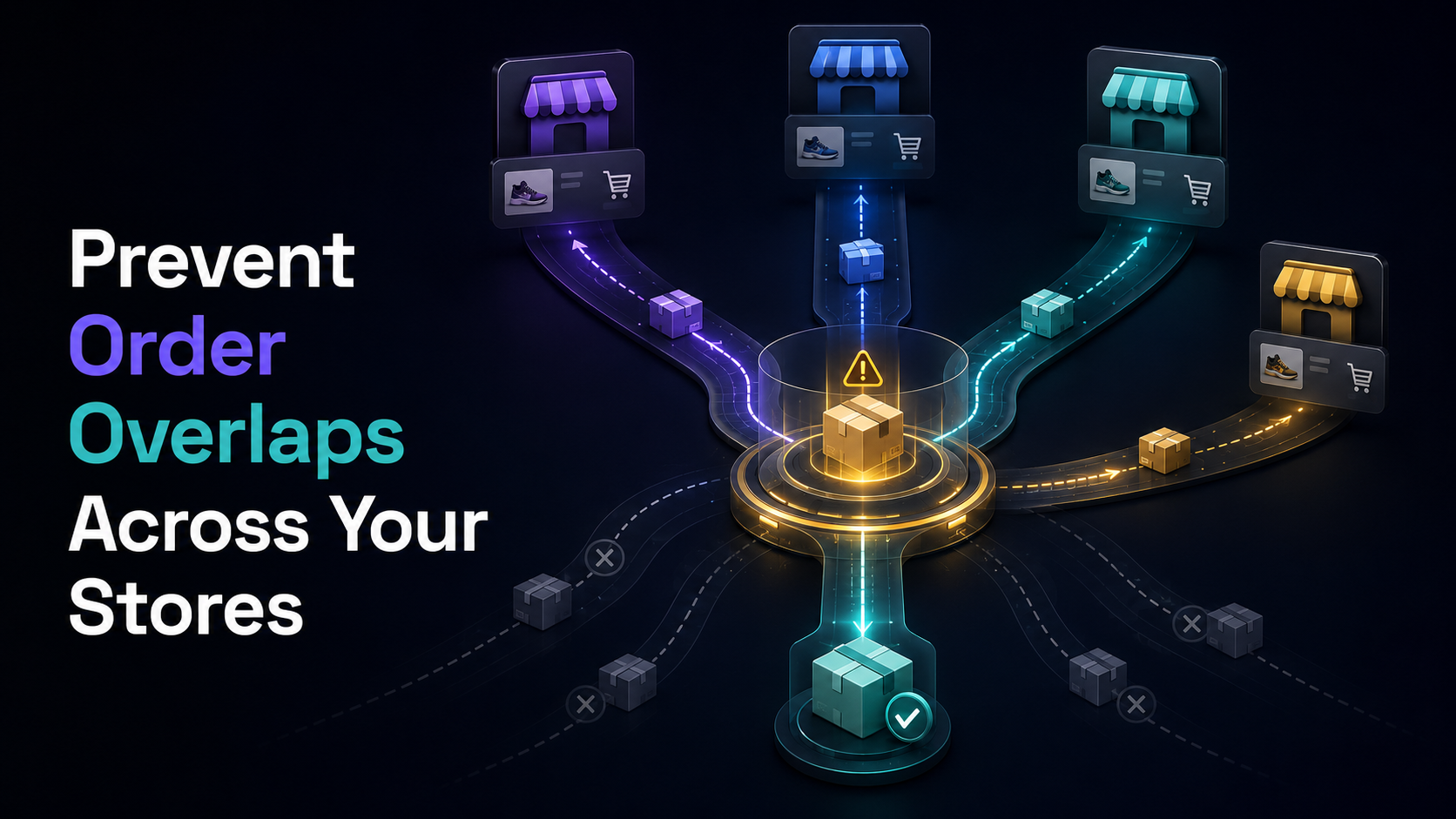
The moment a store starts selling on more than one channel — Shopify plus Amazon, or Etsy plus a wholesale marketplace — a failure mode shows up that a single-channel store never has to think about: two channels selling the exact same unit of inventory within minutes of each other. Nobody made a mistake. The stock count was accurate five minutes ago. It just wasn’t accurate everywhere at once.
That gap between “sold on one channel” and “updated on every other channel” is where order overlaps live. It isn’t really an inventory problem in the traditional sense — it’s a synchronization problem, and it compounds with every sales channel a store adds, not in a straight line but close to it.
Why order overlaps happen in the first place
Overselling across multichannel storefronts almost always traces back to one of a handful of root causes, and they stack on top of each other the more channels a seller runs:
- Manual stock updates. Spreadsheets and channel-by-channel manual edits work fine at low volume and quietly fall apart the moment two people, or two channels, are updating the same product at once.
- Polling instead of real-time sync. Many integrations check for sales every few minutes rather than the instant a sale happens. In that window, any channel can sell a unit that was already sold somewhere else.
- No single source of truth. When Amazon, Etsy, and a storefront each keep their own inventory count instead of pulling from one central number, the counts drift apart by design, not by accident.
- Shared components across bundles and kits. A single component sold individually and inside three different bundles needs its stock decremented in every direction at once — a common blind spot in basic sync setups.
- Demand spikes. A flash sale or a viral moment compresses a normal day’s order volume into an hour, and any sync delay that was harmless at low volume turns into a wave of oversold orders at high volume.
What an oversold order actually costs
An oversold order isn’t a single mistake that gets quietly corrected. It sets off a chain: the order gets cancelled or the customer waits on a backorder, a refund or partial refund often follows, and the seller has to answer for it on whichever marketplace it happened on. Marketplaces track cancellations and defect rates as core seller-performance metrics, and sellers who let that number climb risk losing search visibility, badge eligibility, or the ability to sell at all — on top of the customer who now associates the brand with an order that didn’t show up as promised.
The damage rarely stays contained to one order, either. A customer who gets a cancellation email after “confirming” a purchase doesn’t distinguish between the storefront and the ten different backend systems that failed to talk to each other — they just see a brand that oversold them, and that’s the version of the story that shapes whether they come back.
Real-time sync closes the gap that polling can’t
Shopify’s own guidance on multi-location inventory is built around a simple principle: each location’s stock is tracked independently, a product can only sell from a location where it’s active, and everything shown on the product page reflects that in real time. That design exists specifically to stop a sale from processing against inventory that doesn’t actually exist at the location fulfilling it. The same logic has to extend outward to every external sales channel, not just internal locations — the instant a unit sells anywhere, every other channel needs to know before it can sell that same unit again.
Centralizing inventory beats patching each channel individually
The pattern that actually holds up as channel count grows is centralizing inventory in one place and letting every channel read from it, rather than trying to keep five separate systems reconciled after the fact. BigCommerce describes this directly on its own inventory management page: real-time, two-way syncing updates stock the moment a sale happens on any connected channel, which is what actually eliminates overselling rather than just catching it sooner. Trying to bolt a fix onto each channel separately — a buffer here, a manual recount there — treats the symptom. A single, always-current source of truth that every channel reads from and writes to removes the condition that causes order overlaps to begin with.
Why this problem keeps growing, not shrinking
Selling across multiple channels isn’t a niche strategy anymore — it’s close to the default expectation for where a growing brand shows up next. The National Retail Federation’s 2026 retail trends coverage points to retailers increasingly using automated and AI-driven systems specifically to “reroute shipments on the fly and rebalance inventory across their stores” — which is another way of saying that the sellers pulling ahead are the ones treating cross-channel inventory sync as infrastructure, not an afterthought bolted on once overselling becomes a recurring complaint.
An order overlap isn’t a bad-luck event — it’s a predictable outcome of running inventory across channels that don’t talk to each other fast enough. The fix was never “be more careful.” It’s closing the time gap between a sale happening and every other channel knowing about it.
How to actually prevent order overlaps
- Pick one source of truth for stock. Every channel should read from, and write back to, the same inventory count — not maintain its own copy that gets reconciled later.
- Sync in real time, not on an interval. A sale should decrement stock everywhere within seconds, not the next time a scheduled sync job runs.
- Keep a safety stock buffer on high-velocity SKUs. Holding back a small percentage of “available” stock absorbs the last few seconds of lag that even a fast sync can’t fully eliminate.
- Map bundles and kits to their components. Make sure a sale of a bundle correctly decrements every component it contains, everywhere that component is also sold individually.
- Set channel priority rules for shared inventory. When stock is genuinely limited, decide in advance which channel gets it during a conflict instead of resolving it order-by-order after the fact.
- Reconcile counts on a schedule anyway. Real-time sync reduces overlaps dramatically; it doesn’t replace the discipline of a periodic physical count to catch what automation misses.
None of this requires abandoning any of the individual channels that are working. It requires making sure they’re all fed by the same number, updated at the same speed.
Where automation fits into fixing this for good
This is exactly the kind of problem that doesn’t get solved by trying harder — it gets solved by architecture. Avezant’s multichannel expansion work connects a store’s inventory across every channel it sells on, so a sale on one platform updates every other platform immediately instead of on the next sync cycle. Paired with AI-powered automation that watches stock levels, order velocity, and sync health continuously, order overlaps stop being something a team has to catch after a customer complains and become something the system prevents before it happens.
If overlapping orders, cancellations, or “wait, we sold that twice?” moments are already showing up across your channels, a free audit will map exactly where the sync gaps are and what it takes to close them.