
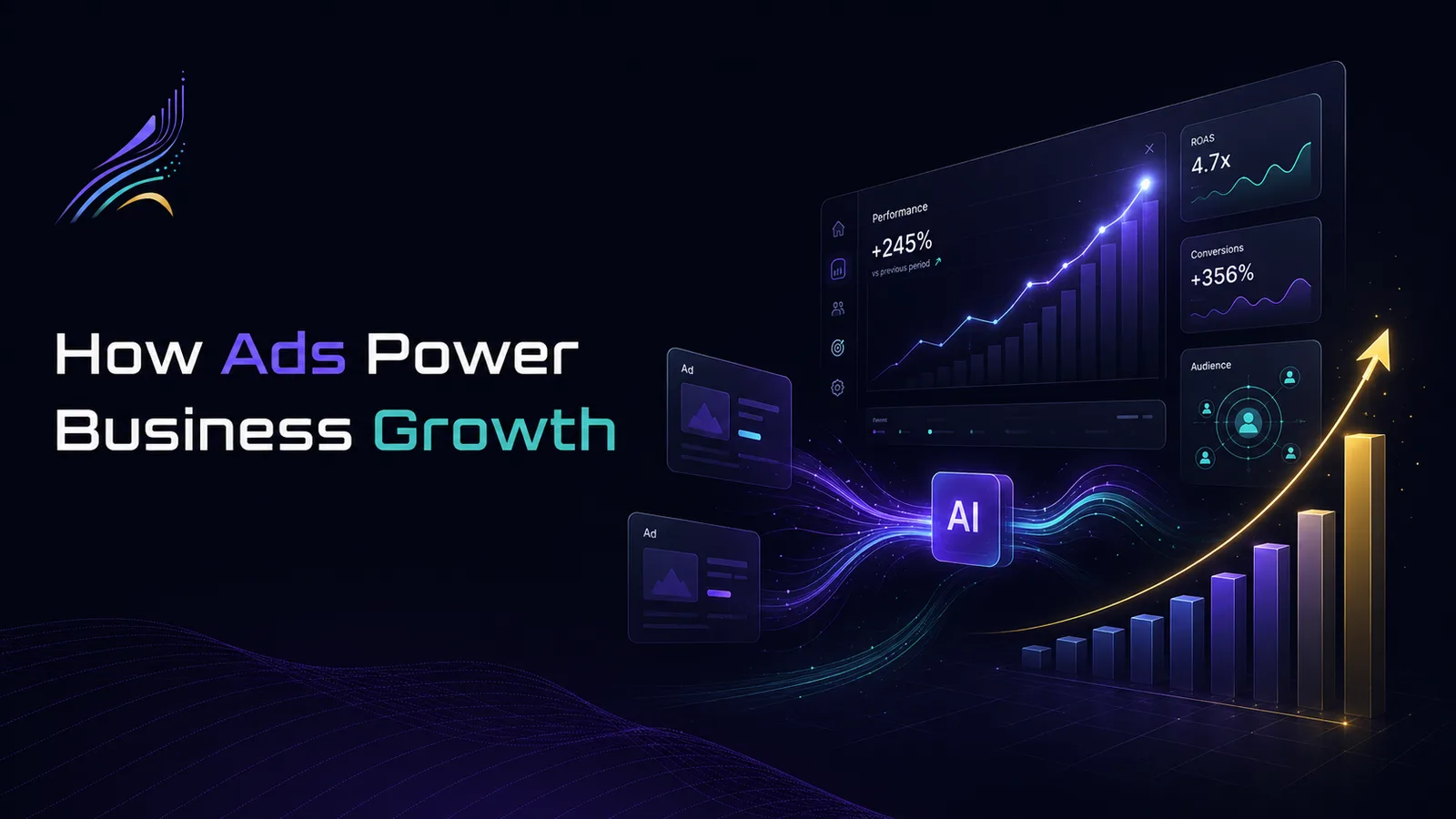
Every ad platform now has an AI layer bolted onto it — automated bidding, generative creative, predictive audiences. The advertising industry is in the middle of a real boom built around this shift, and outlets like the New York Times have been covering it closely. But there’s a gap between that headline and what actually happens inside a small or mid-size business’s ad account. Turning the AI on doesn’t turn the results on. A real AI advertising strategy still does almost all of the work.
That distinction matters more than it sounds. Businesses that treat AI as a shortcut around strategy tend to burn budget quickly and blame the platform. Businesses that treat AI as an accelerant on top of a real strategy tend to get compounding returns. The difference between those two outcomes isn’t the algorithm — it’s everything that happens before the algorithm gets involved.
The AI ad boom is real, but it isn’t magic
The current wave of investment in AI-driven advertising is genuine: platforms are racing to automate bidding, generate creative variants on demand, and predict which audiences will convert before a campaign even launches. It’s a meaningful shift, and it’s reshaping how ad budgets get allocated across the industry.
What that coverage doesn’t always make clear is that the AI is optimizing within a structure a human still has to build. It can find the best-performing version of an ad faster than a person can. It can shift bids in real time based on signals a person would never catch manually. What it can’t do is decide who your customer actually is, what problem you solve for them, or which offer is worth testing first. That part is still strategy, and skipping it is the single most common reason ad spend underperforms.
Why AI advertising strategy still decides the outcome
The clearest evidence for this is in the numbers, not the pitch. Case studies from LYFE Marketing show a local gym generating over 200 lead conversions at roughly $4 per lead on a modest budget — not because of a smarter algorithm, but because the targeting was built around people actively searching for a solution, instead of trying to manufacture demand out of a cold audience.
The same case studies show something even more telling: an e-commerce account that cut its cost per conversion by roughly a quarter simply by adding remarketing — re-showing ads to people who had already visited the site once. That’s a strategic decision, not a technical one. The AI bidding system can execute a remarketing campaign brilliantly once it exists. It has no way of telling a business it should build one in the first place.
AI can optimize a bid in milliseconds. It can’t decide who your customer is, what problem you solve for them, or when they’re ready to buy. That’s still strategy — and it’s still the part that separates a strong return from a wasted budget.
Measuring what actually matters
Most ad accounts are read at the surface: click-through rate, cost per click, maybe a conversion count inside the platform itself. That’s enough to tell you the ad is working in isolation. It’s not enough to tell you it’s working for the business. A more rigorous, data-driven approach means actually connecting ad spend to downstream sales performance — not just what the platform reports, but what shows up in revenue once orders are placed, refunds are accounted for, and repeat customers are separated from one-time clicks.
That’s a harder number to get to, and it’s exactly the number that tells a business whether to scale a campaign or kill it. Without that loop closed, “the ads are performing well” and “the ads are making money” can quietly become two different claims.
What a real AI advertising strategy looks like
In practice, the businesses getting real returns from AI-assisted advertising tend to do the same handful of things well before they ever touch an automated bidding tool:
- Audience and keyword research first. Targeting people who are already looking for a solution converts at a completely different rate than trying to create interest from nothing.
- Remarketing built in from day one. Repeat exposure to warm visitors is consistently one of the cheapest ways to convert, and it’s a setup decision, not an AI feature.
- AI-assisted bidding and creative testing layered on top. Once the targeting and offer are right, letting automation handle bid adjustments and creative variants in real time is where the technology genuinely earns its keep.
- Spend tied back to real sales data, not platform metrics alone. A campaign that looks efficient inside the ad manager still has to prove itself against actual revenue.
- Continuous testing instead of a set-and-forget launch. The accounts that keep improving are the ones that treat every campaign as a starting point, not a finished product.
Where AI actually earns its place
None of this is an argument against AI in advertising — it’s an argument for sequencing it correctly. Once the strategic groundwork is in place, AI is genuinely good at the things humans are slow or inconsistent at: reallocating budget toward winning ads within hours instead of weeks, generating and testing creative variations at a volume no team could produce by hand, and catching underperformance early enough to fix it before real money is lost. That’s a legitimate advantage, and it compounds the returns a good strategy was already producing.
The bottom line
The AI ad boom is real, and ignoring it means leaving efficiency on the table. But the businesses actually winning with it aren’t the ones with the most advanced algorithm — they’re the ones who did the strategic work first and let AI accelerate a plan that was already sound. Spend without strategy just gets automated faster.
If you want to know whether your current AI advertising strategy is set up to actually benefit from AI-assisted optimization, a free audit is the fastest way to find out.